
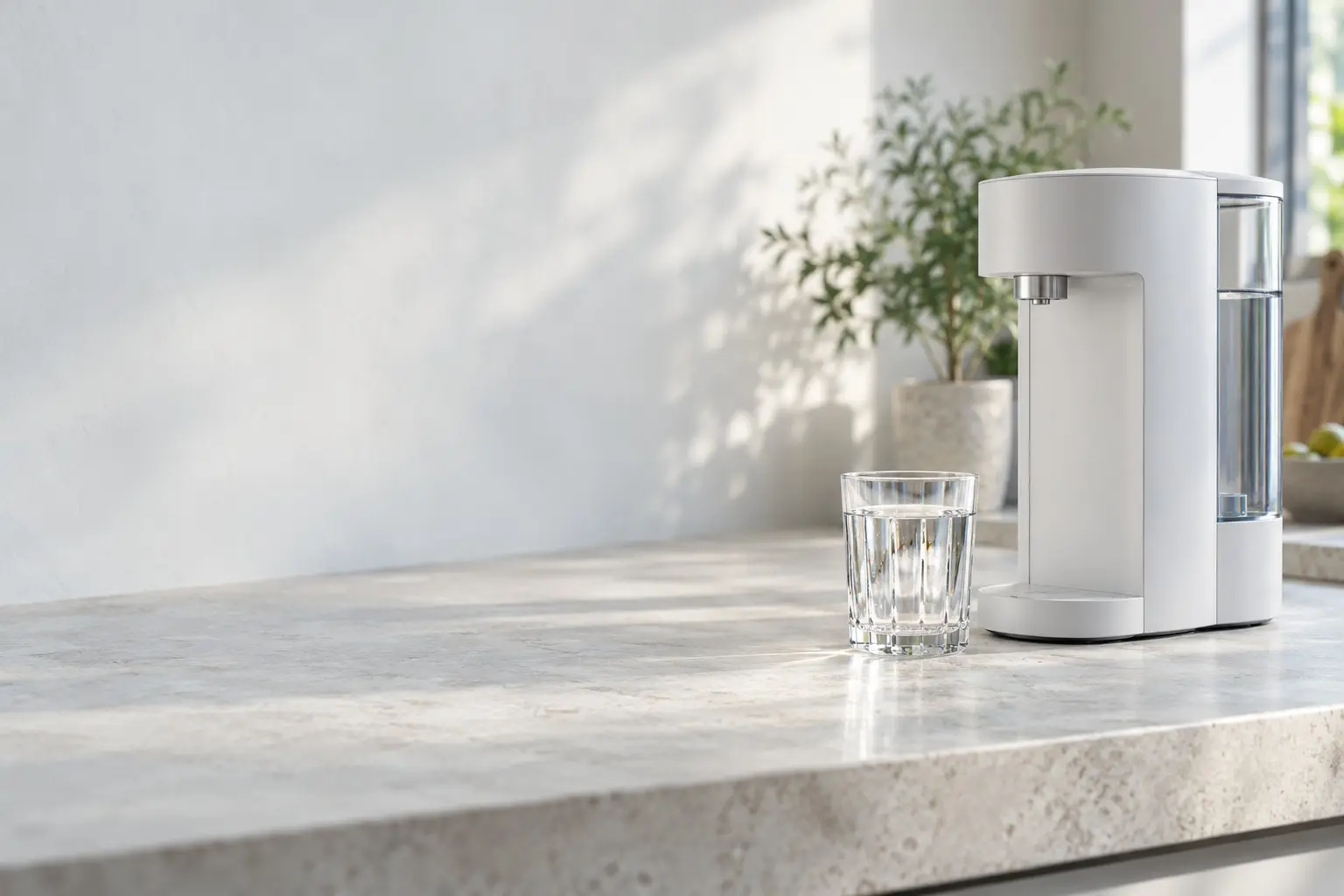
A no-plumbing countertop unit is usually the simplest option for renters because nothing gets drilled and it moves with you. The trade-off is counter space and a daily routine of refilling and emptying tanks. Measure carefully, confirm your lease rules for anything you connect, and remember that your utility's report doesn't cover your building's pipes.
Why renters often start with countertop
Most of the case is simple: a no-plumbing unit needs no drilling and leaves with you when you move. AquaTru, which sells both formats, describes its countertop models as ideal for renters, and its under-sink model requires installation, including drilling into your pipes, for which it recommends a certified plumber. That’s a manufacturer’s framing, but the installation difference is a matter of fact.
Don’t assume, though. Some products sold as countertop units still connect to your plumbing. The Waterdrop K6, for instance, is described as a 15-minute DIY installation designed to fit standard kitchen faucets. If you need to leave the plumbing alone, confirm that a unit needs none before you get attached to it.
What to measure in a small kitchen
Published dimensions only tell you part of what you need. Here’s how two no-plumbing models compare:
Space and capacity for two no-plumbing units
| Specification | AquaTru Classic | AquaTru Carafe |
|---|---|---|
| Size (W x D x H) | 12 x 14 x 14 in[1] | 7.5 x 14 x 13 in[2] |
| Weight | About 17 lb[1] | About 9 lb[2] |
| Treated water held | 0.75 gal[1] | 0.5 gal[2] |
| Tap water tank | 1 gal[3] | 0.66 gal[2] |
| How you get the water | Push-button dispenser[1] | Removable 64 oz borosilicate glass carafe[2] |
- AquaTru Classic, size (w x d x h): An undated AquaTru specification sheet hosted by a retailer lists 11.5 in wide and 16.3 lb. We use the current product page.
- AquaTru Classic, tap water tank: From an undated manufacturer sheet. The current product page does not state tap-tank size.
Sources for this table (3)
- AquaTru Classic product page, AquaTru. Accessed November 2, 2026.
- AquaTru Carafe product page, AquaTru. Accessed November 2, 2026.
- AquaTru Model AT2000, AT2010 Specifications, hosted by The Home Depot, AquaTru. Accessed November 2, 2026.
These are the things to check with a tape measure:
- The space under your wall cabinets. Allow for lifting a tank up and out, not just for the unit’s height.
- The sink and faucet. A tank has to fit under the faucet and through whatever is around your sink.
- The counter depth. Both units above are listed at 14 inches deep. Leave a little extra for the power cord and for reaching the tanks.
- Where the outlet is. A short walk to the outlet may leave the unit somewhere inconvenient.
- The route to the sink. Water weighs a little over 8 pounds a gallon, and you’ll carry it.
Width is the clearest difference between these two models. If counter width is your tightest limit, the Carafe’s narrower body may decide the question, as long as its capacity works for your household.
The routine you’re signing up for
On a fill-by-hand system, the routine is part of the product. Going by AquaTru’s documents, it goes like this:
- Refilling. You take out the tap tank, carry it to the sink, and fill it. Treated water takes time to make: about 15 minutes per tank for the Classic in normal use.
- Emptying. When it’s time to refill, the tank still holds leftover water, and the manual says it must be discarded every time. The Carafe’s manual says the same.
- Cleaning. The Classic’s manual calls for cleaning the tanks weekly.
- After changing filters. The manual says to discard the first two full tanks.
- Noise. The manual notes that the pump makes noise during filtration. We didn’t find a decibel figure in the documents we checked, and we haven’t heard one running. If the kitchen shares a room with where you sleep, that’s worth asking about.
How much capacity do you need?
AquaTru’s own guidance is to choose the Carafe for compact spaces and one or two people, and the Classic for larger countertop capacity. Treat that as a starting point and do the sums for your home. A household that fills bottles and cooks with filtered water will use far more than one person who only drinks a few glasses a day.
Capacity also affects what you pay. The Carafe’s filters are rated for half the gallons of the Classic’s, so heavy use makes it more expensive over time. See the Classic vs. Carafe comparison for the numbers.
What your water report won’t tell you
Your utility’s Consumer Confidence Report describes the water it supplies. It doesn’t describe the pipes between the main and your faucet, and in an apartment building those can be a long and unknown run.
EPA says lead usually gets into drinking water through corrosion of plumbing, and that homes built before 1986 are more likely to have lead pipes, fixtures or solder. If this concerns you, ask your landlord what’s known about the building’s plumbing and consider testing at your own tap.
Then check any filter you’re considering against what you found. A claim to reduce lead has to apply to that exact model, under the certification listing and the conditions on its data sheet. The CDC’s guidance points to the same habit: check the label and the database, not just the marketing.
A quick way to decide
- You rent, or you may move soon: start with no-plumbing units, and rule out anything that connects until you’ve read your lease.
- Your counter is very narrow: measure first, then compare widths. Capacity comes second.
- You use lots of filtered water: weigh a larger tank against the counter space it takes, and check what filter limits do to your costs. A dedicated faucet may suit you better if you’re allowed one, as our countertop vs. under-sink guide explains.
- You won’t keep up with a refill routine: be honest about that now. A cheaper, simpler product you actually use may serve you better.